Windsor Castle
We woke up early this morning (7:50 am) and headed out to Windsor Castle. It was a little adventure to get there. We took the Tube from Kensington to Paddington Station.

Then from Paddington we took the Train to Slough, and caught a connection to Eton/Windsor. Windsor is a quite and quaint little town. The Castle is extraordinary. Using our London Pass we entered the “fast pass” line and quickly entered the castle area. The Castle is over 800 years old and is the oldest actively used castle in the world. Queen Elizabeth splits time between there and Buckingham Palace in London. At the mouth of the Thames river, the Castle originally was a fortification built by William the Conquerer. In 1165, King Henry II started construction of the residential buildings. The castle remained under construction for several hundreds of years.
One of the Castle’s most notable features is the Round tower called the “Keep”. The Keep is the last line of defense in case of a siege. The building is quite impressive.
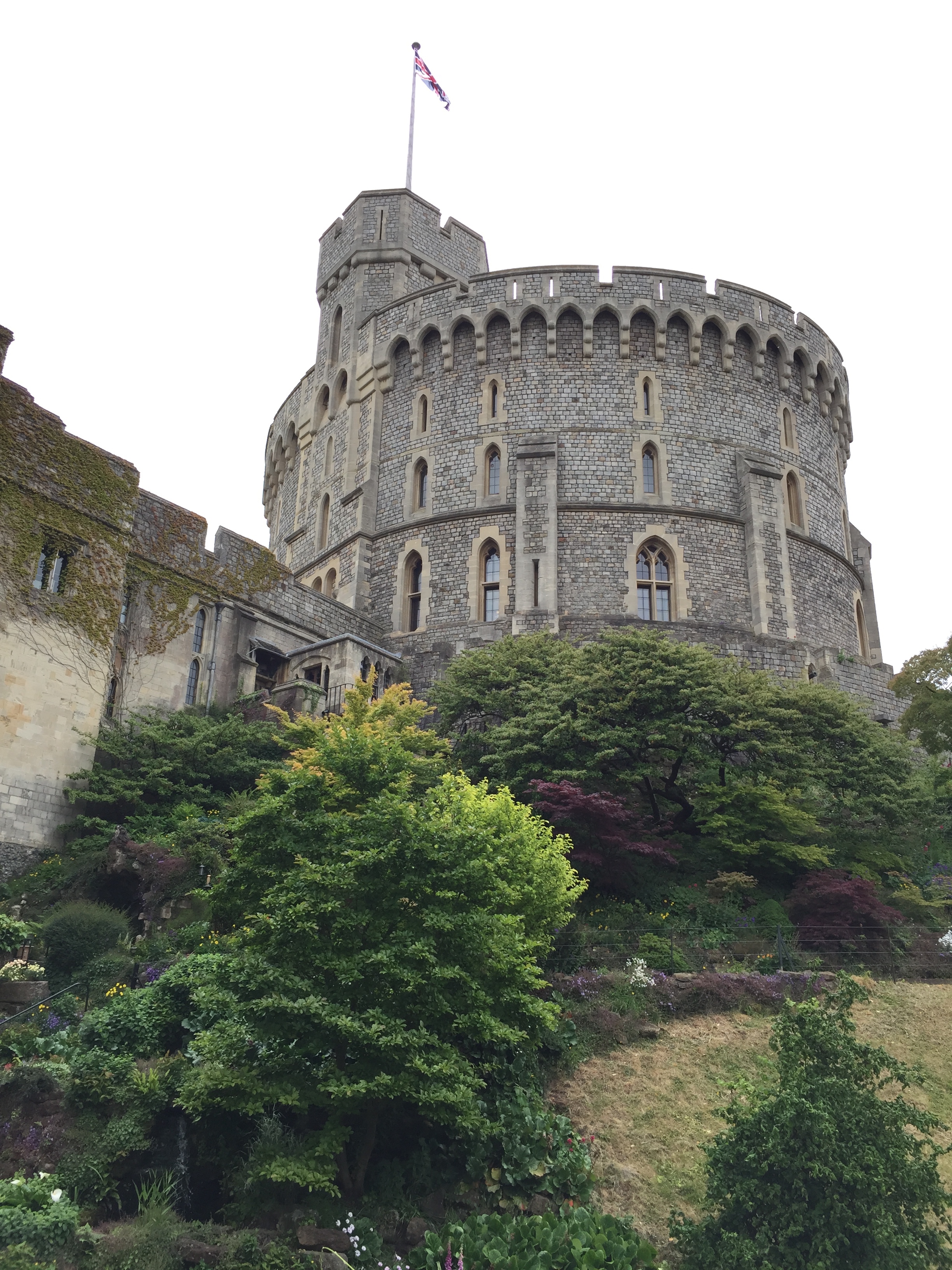
When the Queen is at the castle her flag is raised. She was not there today, as only the Union Jack (the British Flag) flew today. The Keep is surrounded by a Moat. Unlike traditional moats this one did not contain any water. The Moat now is a luxurious garden. Even the pathway leading to the Keep is impressive.
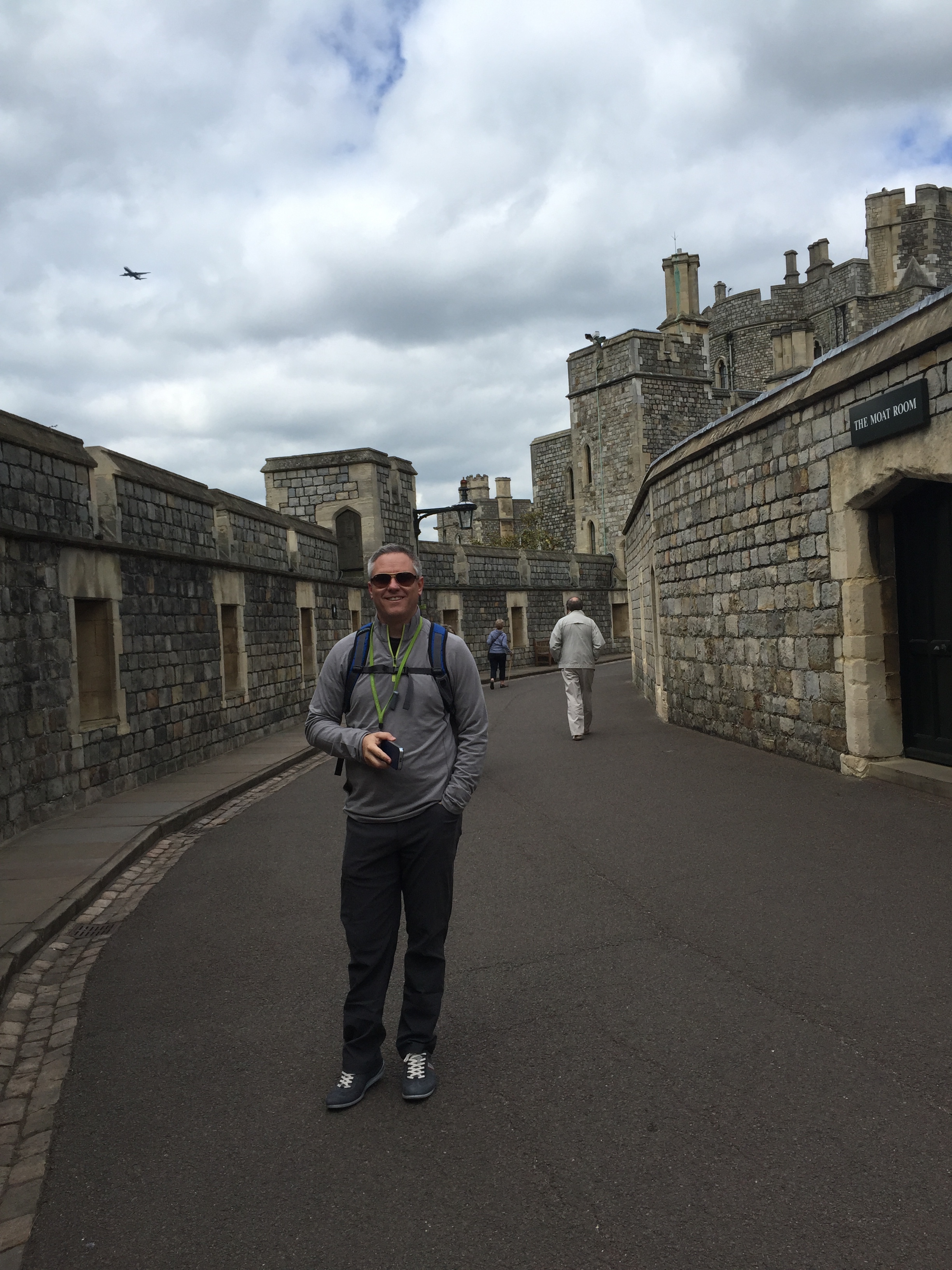
Its hard to tell in this photo, but on my left are openings where the archers would shoot arrows at any enemies.

As you can see the opening where the archers sat was wider than the front, allowing him to swing from side to side to aim, while limiting his exposure to the outside.
One of the most impressive areas inside the castle is the main dinning area. Destroyed by a fire in 1992, the roof of this area was completely rebuilt.
Tiny shield/crests of knights hang on the ceiling and walls, each representing a distinguished knight.

A few shields are whited out. These represent knights who because of their wrongful actions lost their title. The shields were not removed, only whited out, as a reminder to all knights of their duty.
Our tour included access to the “State Rooms” These rooms which included waiting rooms, chamber rooms, closets, and bed rooms for both the King and Queen. The interior contains various coats of arms, ancient hand guns and muskets, works of art by famous painters such as Van Dyke and Rubens. Tiff and I both enjoyed looking at a painting by Titian called “The Lovers.”
In 1924, Queen Mary’s cousin, Princess Marie Louise commissioned the creation of a miniature house. Queen Mary is Queen Elizabeth II’s grandmother.
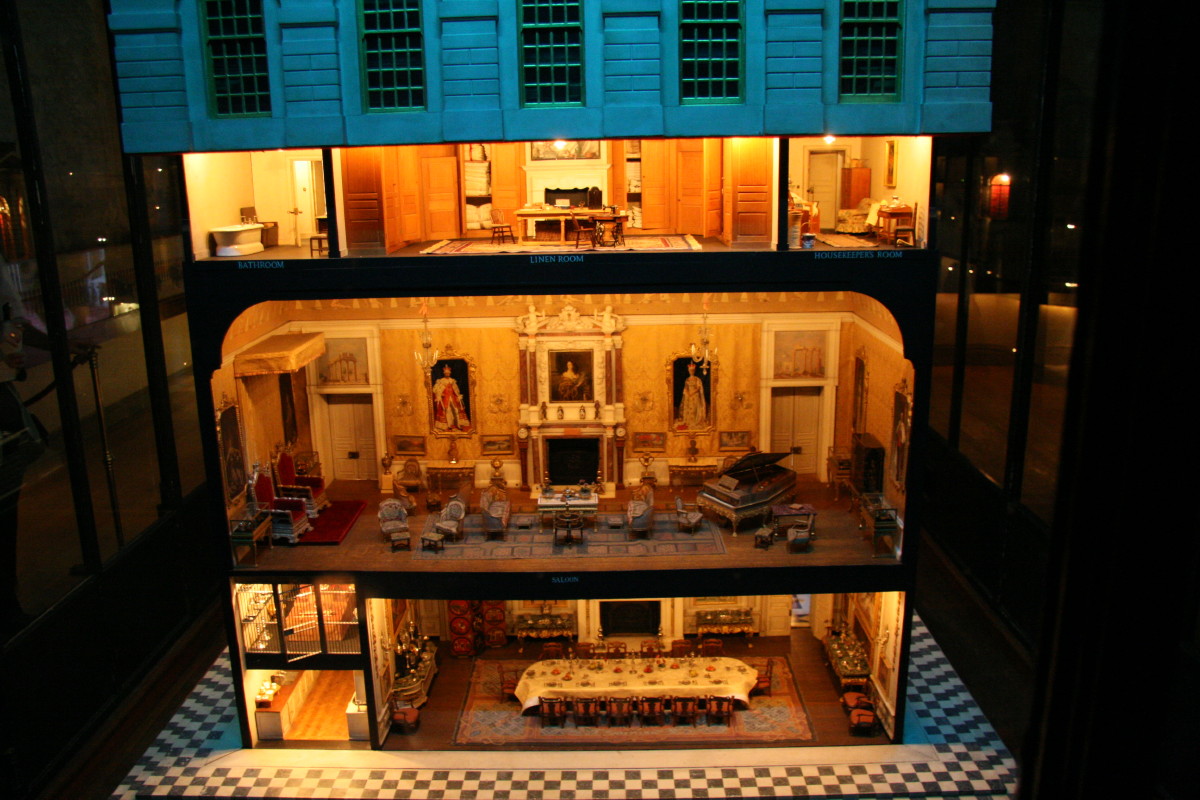
Apparently, Queen Mary enjoyed tiny little artifacts. Knowing this Princess Marie Louise raised the money to create a perfect scaled miniature house. The house includes electricity, running water, miniature works of art, real silver plates and silverware. It is pretty impressive.
Our last stop at Windsor included a stop at St. George’s Chapel. The chapel is a gothic display of art. I was most impressed, however, with the Dean of the Chapel, who repeatedly pointed out the main purpose of the Chapel is that of a place of worship. Each day service is conducted there. Construction of the Chapel began in 1475 by Edward IV, and was completed by Henry VII. The Chapel is the spiritual home of “the Order of the Garter.” The Order of the Garter is the highest order of knights in Great Britain.

The Order in past ages included individuals such as Winston Churchill, and General Montgomery. Currently the Queen, Prince Charles and 29 others sit in the order. Each knight has a banner and a crest displayed at the Chapel. When a knight of the order dies, their banner and crest are removed. Upon the selection of a new knight, that individual’s banner and crest replace that of the fallen knight.
The Chapel also acts as the final resting place of several dignitaries and monarchs including Charles I (who was beheaded by Oliver Cromwell); Henry VIII; Jane Seymour (his third wife who died of natural ailments); Edward IV; Edward VII; George IV; Queen Elizabeth’s Mother and Father (King George VI (King’s Speech) and Queen Mother Elizabeth); Princess Margaret (Queen Elizabeth’s sister, the only monarch to be cremated and buried in the chapel); George V and Mary (Queen Elizabeth’s grandparents). Their memorial is a beautifully marble carved statute.
The last thing we witnessed at Windsor was the ceremonial changing of the guard. A band of finely dressed soldiers march down through

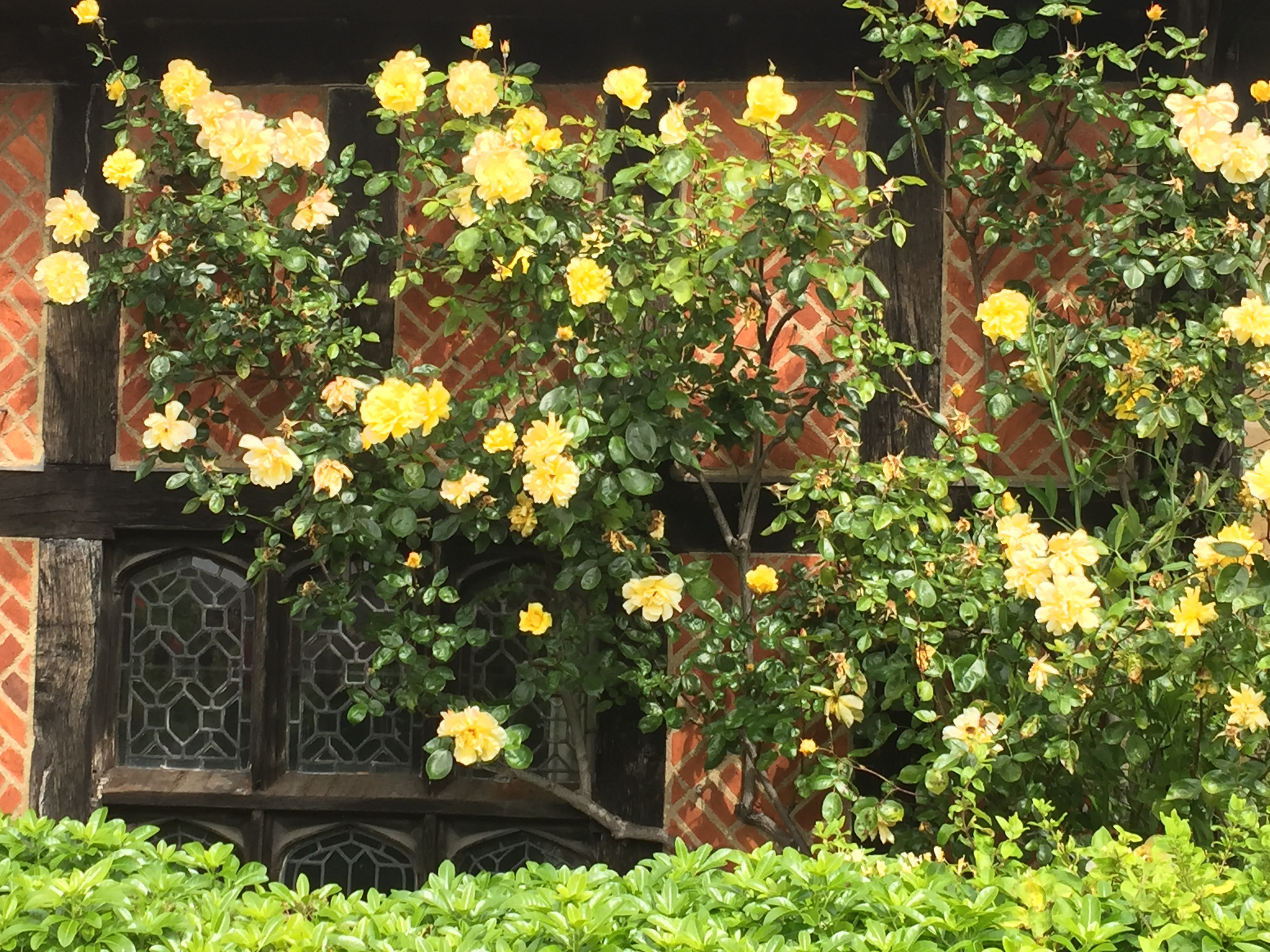
Windsor into the Castle to the final place to change the guard. The site is very impressive. Tiff took a picture of the roses next to the Guard House at Windsor, and i thought it turned out really good, so I included it here.

Before returning from Windsor to London we did a little shopping and stopped to have lunch at a little Indian (Country not Native American) restaurant by the castle called Dhinchak Restaurant. I ordered the Kahari Curry (a little on the spicy side) and Tiff ordered the Buttered Chicken Curry. The flan and curry was excellent. Not sure I’ve had better.
Notting Hill/Portobello Road
Upon arriving back to London, Tiff and I stopped in Notting Hill to check out the market. We stopped by one of the most famous markets “Portobello Road.” To be honest I was a little disappointed. I thought it would be a place to haggle a little bit. Rather it was more like walking down a street with dozens of consignment or thrift stores. Maybe shopping on the weekend is better.
We did find a book store (Book & Comic Exchange) that looked identical to the one Hugh Grant owned in Notting Hill. Tiff and I did not see a sign claiming to be in the movie, but i’m sure its the store. I’m going to look into this :-).
Kensington Palace
 Because of the nice weather we decided to walk from Notting Hill to our hotel in Kensington. We really did not have anything like that planed, so it was kind of spur of the moment. We ended up taking the Kensington Garden Parkway down to our hotel. The parkway is lined with trees and the homes and embassy’s of several diplomatic countries, including Russia, France, and Mexico.
The avenue of trees lining the street, and the quite were a welcome retreat from the noisy city. It was a really peaceful walk. On our way we noticed Kensington Palace on our left and we decided to quickly stop by.

Until touring the gardens and palace I did not realize Kensington was Princess Diana’s home from 1983 until her death in 1997. After Diana’s death mourners placed flowers and messages at the gate and formed a procession in front of the palace.
The Palace also was the home of Princess Margaret, the Queen’s sister, until she died in 2002. Currently, the Palace is the residence of William and Catherine, the Duke and Duchesse of Cambridge, and their two children George and Charlotte.

The palace is surrounded by a park and contains a garden of sunflowers and natural flowers. Inside the palace reminds me of some of the older buildings in America such as Monticello and Mount Vernon, just larger and grander. In the ball room there are statutes plated in gold, it is quite impressive. Some of the highlights of the castle are the discussions of William and Mary, and the display of Queen Elizabeth’s and Princess Diana’s formal dresses from the 1950’s through the 1980’s.
Jack The Ripper Tour
Our last stop of the night was to go to the East End of London, in an area called Whitechapel. In 1888, this area was filled with prostitutes, vagabonds, thieves, and the dregs of society. The East end was considered by most Londoners as the most dangerous part of the city. Between August 31, 1888 and November 9, 1888, five women (Mary Nichols, Annie Chapman, Elizabeth Stride,Catherine Eddows, and Mary Kelly) were brutally murdered and mutilated by an unknown assailant. The bodies were left at various points throughout Whitechapel.
We booked our tour with Discovery Walks at http://www.jack-the-ripper-tour.com. Discovery walk boosts that each guide is a “Ripper” specialist. Our tour guide was Philip. Philip reminded me a little of Ricky Gervais, with his quick wit, and dry sense of humor. During the tour, Philip took us to various parts of Whitechapel and described the events, and showed us pictures of what the place used to look like and a picture of the bodies how they were found. Each time one of us would look at one of the crime scene photos he would call us “sickos.” He was very good.
Philip explained that the murders went unsolved because they were committed in areas which most people avoided, and which were dimly lit. He explained that the gas lamps of 1888 would show no more than a modern kitchen fridge would, and were sparsely placed in the city. Most policemen, let alone, individuals would not venture down some of the streets where the victims were found. His conclusion at the end was we probably would never know who Jack the Ripper was. But he believes two things were certain, he was a local, and he had enough money to have his own room. His theory is based on having to know the alleys and streets in Whitechapel very well, so acquainted only a local would know. Plus because of the blood on his hands and face, he would need a place to go to where no one else could see, thus the need for his own private room. Both seem plausible theories.
In the end the tour was worth our time.
Well that was a lot for day 3.
Cheers!

 Christiansen Travel